
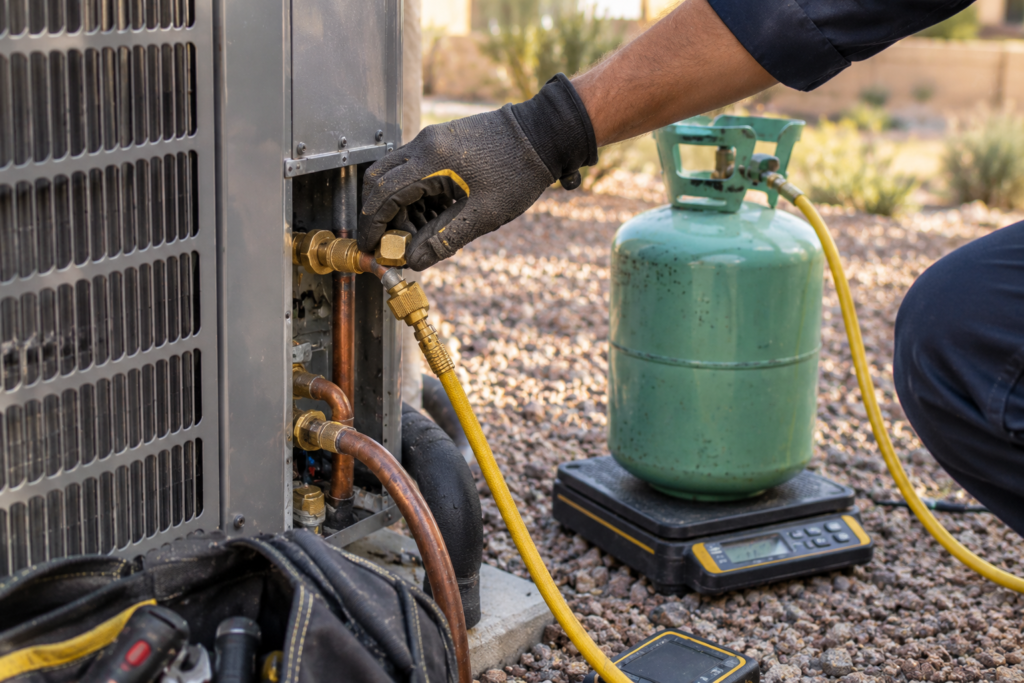
Your AC is running, but the air coming out isn’t cold. Someone mentioned a “recharge.” Now you want to know what that costs before you call anyone.
Short answer: it depends on the refrigerant your system uses, how much it needs, and whether there’s a leak. The longer answer matters more, because a recharge is not a routine service. If your AC is low on refrigerant, something let it out.
What Does an AC Recharge Cost in Mesa?
Prices vary by company, but many homeowners pay roughly $200 to $500 for a basic recharge on a modern R-410A system. That range assumes no leak repair. Systems that still run R-22 cost much more, because that refrigerant is no longer made and the price per pound is several times higher. If there’s a leak, the repair is a separate cost and can be larger than the recharge itself.
Most Mesa companies quote a recharge by the pound of refrigerant, plus a service fee for the visit and testing. That’s why a phone quote without seeing the system is only a rough guess.
Want an exact number for your unit? Call (480) 896-9677 or look at our refrigerant recharge service. We give you a firm quote before any work begins.
What Changes the Price
- Refrigerant type. Older systems use R-22, which is no longer produced in the US and costs far more per pound. Newer systems use R-410A, which is cheaper.
- How much your system needs. A system that’s a little low costs less than one that’s nearly empty.
- System size. Bigger tonnage holds more refrigerant.
- Leak repair. If there’s a leak, adding refrigerant without fixing it is money down the drain.
- Access. A unit that’s easy to reach takes less time than one boxed in or on a roof.
Why a Recharge Alone Is Often a Waste of Money
Your AC doesn’t burn through refrigerant like a car burns gas. It’s a sealed loop. If the level is low, it leaked out somewhere, usually at a coil, a fitting, or a line.
Top it off without fixing the leak and the cooling comes back for a few weeks or months. Then it fades again, and you pay a second time. Some homeowners repeat this for two or three summers before finally fixing the leak.
A good technician finds the leak first. We cover how that works in our freon leak detection service, and our post on refrigerant leaks in desert conditions explains why Mesa’s heat makes small leaks worse.
Signs Your AC May Be Low on Refrigerant
- Air from the vents is cool but not cold, or it’s warm.
- Ice on the copper line or on the indoor coil.
- A hissing or bubbling sound near the unit.
- The AC runs nonstop but the house won’t reach the set temperature.
- Your electric bill climbs with no change in how you use the AC.
These can also point to a dirty filter, a failed capacitor, or a bad fan motor. Before you assume it’s refrigerant, run through the steps in how to troubleshoot an AC that isn’t cooling.
What a Proper Recharge Visit Includes
- Pressure and temperature readings with gauges, so the technician knows the system is actually low.
- A leak check before adding anything.
- The right refrigerant, in the amount listed on your unit’s data plate. Not “until it feels cold.”
- A final test of the temperature drop across the coil to confirm the AC is cooling the way it should.
Only certified technicians can handle refrigerant. Releasing it into the air is illegal, so avoid anyone offering a cheap DIY can or a “quick top-off” with no gauges.
Recharge, Repair, or Replace?
If your unit is under about 10 years old and the leak is small and easy to reach, repair plus recharge usually makes sense. If it’s an R-22 system, has multiple leaks, or the coil itself is failing, the repair bill can rival the value of the unit. In that case, read when to replace vs repair your AC before you spend money on a recharge.
Not sure which case you’re in? A system diagnostic check tells you exactly what’s wrong before you approve any work.
AC Recharge FAQs
How often should an AC be recharged?
Never, on a schedule. A healthy system keeps its refrigerant for its whole life. If it needs a recharge, there is a leak to find.
Can I recharge my AC myself?
No. You need gauges, the right refrigerant, and EPA certification to handle it. Overcharging can damage the compressor, which costs far more than the recharge.
How long does an AC recharge take?
The recharge itself is usually quick. Finding and fixing a leak first is what takes time, and it depends on where the leak is.
Why is my AC still not cold after a recharge?
Either the leak is still there, or refrigerant wasn’t the problem. A bad capacitor, a dirty coil, or a failing compressor can all cause the same symptoms.
Do you offer emergency service?
Yes. If your AC quits in the middle of a Mesa summer, call (480) 896-9677 or see our emergency AC repair page.
Get a Straight Quote
We’ll check the pressures, find the cause, and give you the price before we touch anything. Call AC Repair Mesa at (480) 896-9677 to book.
Leave a Reply